What Happens Inside a Black Hole? Exploring the Unknown Interior
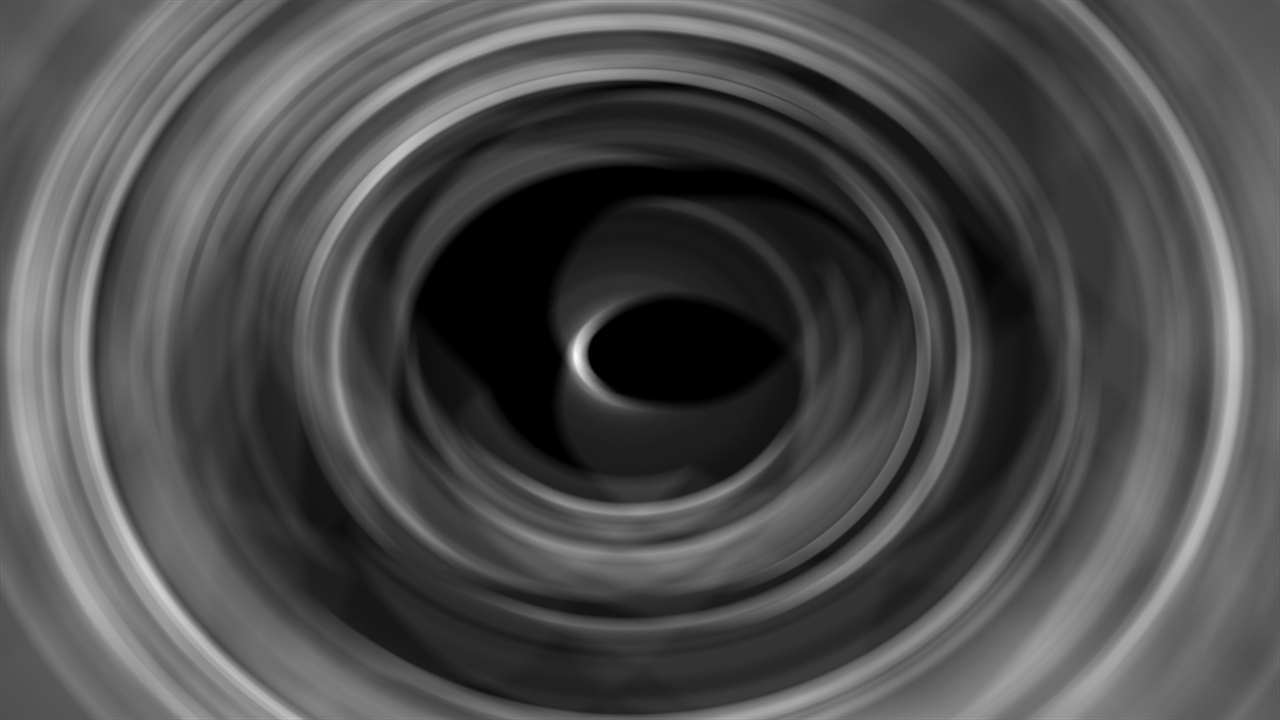
Black holes are among the most mysterious objects in the universe. While scientists understand how black holes form and how they interact with their surroundings, what happens inside a black hole remains one of the greatest unsolved mysteries in physics. Crossing the event horizon—the point of no return—takes you into a realm where spacetime is warped beyond recognition and where our current theories break down.
Why the Interior Is So Mysterious
The main reason we know so little about a black hole’s interior is simple: no information can escape from inside the event horizon.Anything that crosses the horizon is cut off from the outside universe, including:
- Light
- Matter
- Particles
- Signals
- Even information itself (according to general relativity)This makes direct observation impossible. We must rely on mathematical models, theoretical physics, and indirect clues.
The Point of No Return: Crossing the Event Horizon
The event horizon marks the boundary where escape becomes impossible. But for a falling observer, surprisingly, nothing special appears to happen at this boundary—especially for large black holes.
From the perspective of the falling observer:
- You drift past the event horizon without noticing anything
- Tidal forces remain mild in supermassive black holes
- Time appears normal to you
From the perspective of an outside observer:
- You appear to slow down
- Light from you becomes redshifted
- You freeze at the horizon, fading awayThese two perspectives are both correct within relativity.
Inside the Horizon: Where Space and Time Swap Roles
Once inside the horizon, the structure of spacetime changes profoundly.
Outside the black hole:
You can move in any direction in space (left, right, up, down).
Inside the black hole:
All possible paths lead inward, toward the singularity.In a sense, falling inward becomes as inevitable as moving forward in time. You cannot stop yourself or turn around, even at the speed of light.This is one of the strangest consequences of general relativity.
The Singularity: A Point of Infinite Density
At the center of a black hole lies the singularity—a region where density becomes infinite and spacetime curvature becomes infinite.General relativity predicts:
- Matter collapses to zero volume
- Density becomes infinite
- The curvature of spacetime becomes infinite
Why this is a problem:
In physics, infinities usually signal the breakdown of a theory.The singularity tells us that general relativity is incomplete. A better theory of gravity—likely quantum gravity—is required to describe what really happens.
Different Types of Black Hole Interiors
Not all black holes are the same. Their interiors may be surprisingly different depending on their type.
1. Schwarzschild Black Hole (Non‑Rotating, No Charge)
The simplest type.Interior structure:
- Event horizon
- Empty region of spacetime
- Singularity at the centerEverything inside moves inevitably toward the singularity.
2. Kerr Black Hole (Rotating)
Rotating black holes are much more complex. They may contain:
- An outer event horizon
- An inner event horizon
- A ring-shaped singularity
- An ergosphere (outside region where rotation drags spacetime)
Possible interior features:
Some models predict:
- Travel through the ring singularity
- Access to other regions of spacetime
- Wormhole-like structuresHowever, most physicists believe these exotic structures are unstable.
3. Reissner–Nordström Black Hole (Charged)
Charged black holes are theoretical, but their interiors include:
- Two horizons
- A central singularity
- A possible inner region with exotic spacetime geometryAgain, these solutions are mathematical and unlikely to exist in nature.
What Happens to Matter Falling Inside?
Matter entering a black hole undergoes extreme transformations.
1. Spaghettification
Tidal forces stretch matter as it approaches the singularity.
2. Compression into extreme states
Matter becomes denser than atomic nuclei.
3. Possible exotic phases
Theories propose:
- Quark–gluon plasma
- Degenerate quantum states
- Hypothetical “Planck matter”We lack the physics to describe these conditions fully.
Can the Interior Lead to Another Universe?
Some theories of quantum gravity suggest that singularities might not destroy information, but instead “bounce,” creating a new region of spacetime.This leads to ideas such as:
- Black hole cosmology (our universe formed inside a black hole)
- Wormholes connecting distant regions
- Baby universes budding inside black holesThese ideas are speculative but mathematically possible in certain models.
The Firewall Paradox
In 2012, a new theory proposed that the event horizon might not be smooth after all.The firewall hypothesis claims:
- Instead of drifting painlessly inward
- Falling observers hit a wall of high‑energy particles
- This would destroy anything crossing the horizonFirewalls would resolve several information paradox problems—but violate relativity’s predictions.The debate remains unresolved.
Quantum Gravity and the Search for Answers
To understand black hole interiors, physicists need a theory that unifies:
- General relativity (gravity, spacetime curvature)
- Quantum mechanics (particles, information)Candidates include:
- String theory
- Loop quantum gravity
- Holographic principle
- AdS/CFT correspondenceThese theories suggest the interior may be:
- Finite, not singular
- Structured, not empty
- Governed by quantum geometryBut no direct experimental confirmation exists yet.
Why We May Never Know for Certain
Because information cannot escape the interior, we may always lack direct observational evidence of what happens beyond the horizon.Black hole interiors may remain:
- The ultimate theoretical laboratory
- A frontier where physics breaks
- A boundary of human knowledgeEven so, they push scientists to find deeper, more unified laws of nature.
Conclusion
The interior of a black hole represents the most extreme and mysterious environment in the universe. While general relativity predicts a singularity at the center, quantum physics suggests something far more complex. Ideas ranging from ring singularities to wormholes and baby universes highlight how little we truly know.What lies inside a black hole may ultimately require a revolutionary new understanding of reality—one that unites quantum mechanics, gravity, and the very structure of spacetime itself.
References
- Penrose, R. (1965). Gravitational collapse and singularities.
- Hawking, S. (1976). Breakdown of predictability in gravitational collapse.
- Susskind, L. (1995). Black hole complementarity and information.
- NASA/ESA Black Hole Public Data Sets
- LIGO & Virgo gravitational-wave observations
More from Black Holes & Extreme Phenomena
Gamma-Ray Bursts: The Universe’s Most Violent Explosions
Gamma-ray bursts (GRBs) are brief, powerful flashes of high-energy radiation that outshine entire galaxies for a few seconds. They occur randomly across the sky, often billions of light-years away, yet the energy they release is so intense that Earth-based detectors can pick them up instantly. These events push astrophysics to its limits and provide a rare glimpse into the universe’s most extreme processes.
The Darkest Objects in the Universe: How We Detect Invisible Black Holes
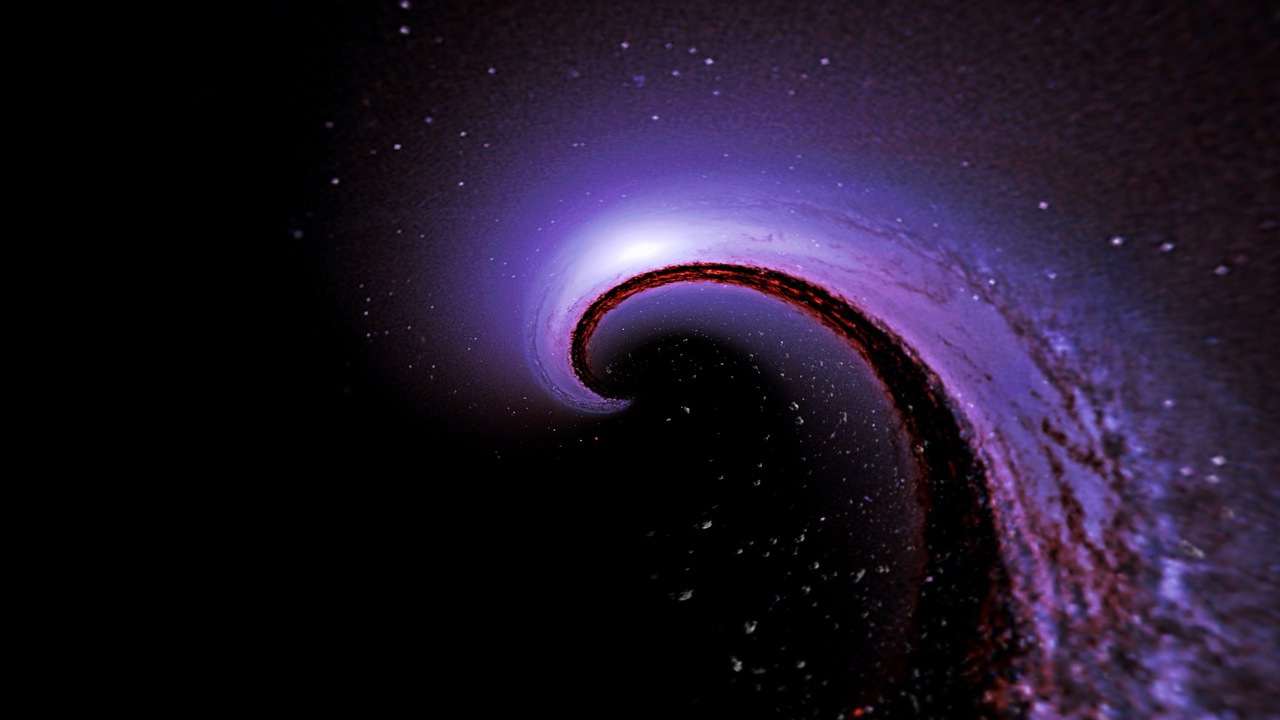
Black holes are famous for being invisible. They emit no light, no radiation, and no signals that can be directly detected with traditional telescopes. Yet scientists have discovered dozens of them and mapped their behavior across the cosmos. How is this possible?

Spaghettification: The Strange Physics of Being Stretched in Space
Black holes are famous for their extreme gravitational pull, but one of the strangest and least intuitive effects they create is spaghettification—a real physical process where objects are stretched into long, thin strands as they fall toward a black hole.
Explore More Topics

Are Smart Telescopes Worth It? A Beginner Buying Guide for 2026
This is why convenience can change the economics of ownership.

The Moon’s Origin: How Earth Got Its Only Natural Satellite
Earth’s Moon is so familiar and constant that it’s easy to forget just how strange its existence is. Compared with other moons in the solar system, it is enormous relative to its parent planet, unusually dense, and positioned in a way that profoundly affects Earth’s tides, climate stability, and even the evolution of life.
Why Mercury Has Extreme Temperatures: A Planet of Extremes
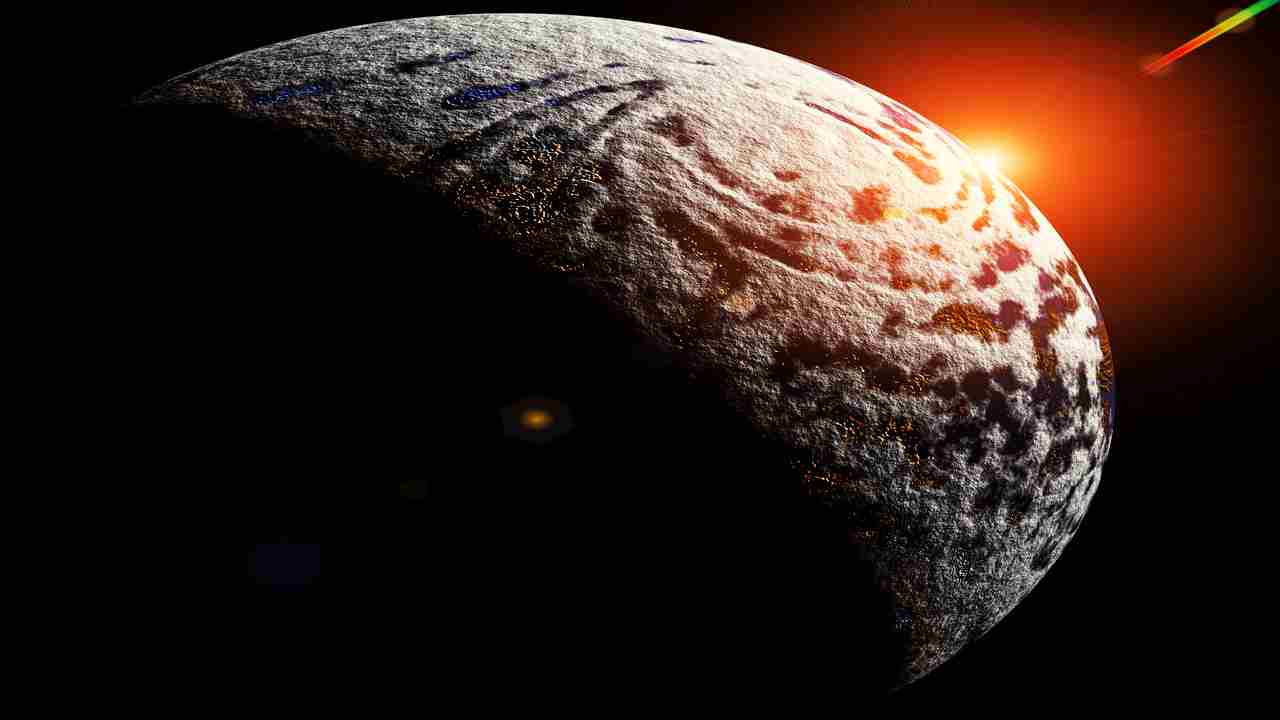
Mercury looks like a simple world at first glance—small, rocky, and covered in craters. But beneath that quiet appearance lies one of the most extreme environments in the solar system. Its temperature swings from scorching heat to freezing cold, making Mercury a planet of brutal contrasts unlike anywhere else.